DORA has shifted operational resilience from a strategic discussion to an active regulatory expectation across the European financial sector, placing greater scrutiny on ICT governance, digital risk oversight, and the resilience of day-to-day operations.
Supervisory authorities such as BaFin, ACPR, and the European Supervisory Authorities (ESAs) are increasingly focused on how organizations manage operational risk in practice, not just how controls are documented internally. Financial institutions are now expected to demonstrate ongoing visibility into ICT systems, third-party providers, incident response processes, and governance controls.
Learn More: European Commission DORA Overview
For organizations using Google Workspace, this creates a different operational challenge than traditional perimeter security. Sensitive financial data now moves continuously across cloud collaboration platforms, browsers, OAuth-connected applications, and third-party SaaS environments.
This is where many operational blind spots begin to appear.
In this guide, we’ll explore the operational risks financial institutions often overlook in Google Workspace environments under DORA, and why operational visibility is becoming just as important as traditional security controls.
Operational Resilience Looks Different in Cloud Environments
Cloud-first collaboration fundamentally changes how operational risk behaves.
Financial institutions increasingly rely on browser-based workflows, SaaS platforms, remote collaboration, external sharing, and third-party integrations to support daily operations. As these environments expand, operational resilience is no longer limited to protecting the network perimeter.
Organizations also need visibility into:
- – who can access sensitive information
- – how files move externally
- – which applications connect to company data
- – how operational workflows are managed across users and departments
For many Google Workspace environments, maintaining that level of visibility consistently becomes difficult as collaboration scales.
The shared responsibility model within cloud environments also plays a major role here. While cloud providers secure the infrastructure itself, organizations remain responsible for how users, applications, permissions, and operational processes interact with sensitive data.
Learn More: Google Cloud Shared Responsibility Model

The Google Workspace Blind Spots Many Financial Institutions Still Have
Most organizations already use native Google Workspace security controls. The challenge is maintaining continuous operational oversight as environments become more collaborative and application-driven.
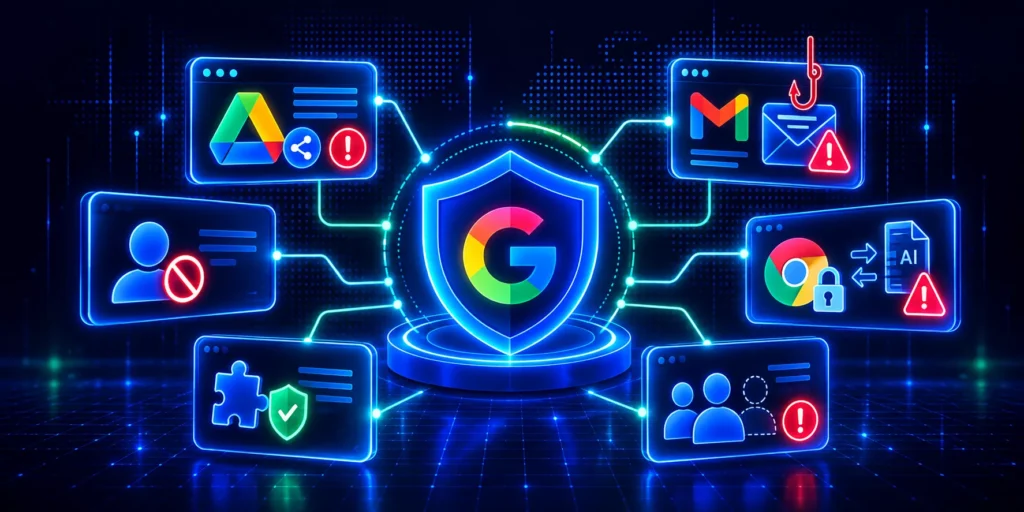
One of the most common blind spots involves external collaboration. Shared Drives, inherited permissions, publicly accessible links, and externally owned files shared into the domain can all create operational exposure that becomes difficult to review manually across large environments.
Permissions also tend to accumulate over time. Delegated Gmail access, admin privileges, legacy sharing permissions, and dormant user accounts often remain active long after operational need disappears.
As organizations grow, these governance inconsistencies become harder to track across departments, remote teams, and distributed workflows.
Another growing challenge is the speed at which employees adopt new tools independently. AI assistants, browser extensions, OAuth-connected applications, and SaaS collaboration platforms are often introduced directly by users without centralized IT review.
Over time, organizations can lose visibility into which applications remain connected, what permissions they maintain, whether they still access sensitive information, and which operational workflows depend on them.
Under DORA, these operational dependencies become increasingly important because organizations are expected to maintain stronger oversight of how third-party services interact with critical business operations.
Why Cloud Collaboration Changes the DORA Conversation
DORA was introduced at a time when financial institutions are becoming increasingly dependent on cloud-first collaboration platforms, browser-based workflows, and interconnected SaaS ecosystems.
This changes the nature of operational resilience completely.
Operational activity no longer happens only inside managed infrastructure or internal systems. Sensitive information now moves dynamically between employees, external partners, browsers, cloud storage systems, AI platforms, and third-party applications.
In many cases, operational workflows evolve faster than governance processes can keep up.
A team may begin using a new AI tool for document analysis. A third-party browser extension may gain access to user data. A department may adopt a new SaaS platform for operational efficiency without formal review.
Individually, these decisions may appear low risk. Operationally, they can create significant visibility gaps over time.
This is one reason regulators are increasingly emphasizing operational resilience rather than purely technical security controls.
The challenge is no longer only preventing attacks. It is understanding how operational activity behaves across constantly evolving cloud environments.
Browser Activity Is Becoming Operationally Relevant
One of the biggest operational shifts happening across cloud environments is the growing importance of browser-based activity.
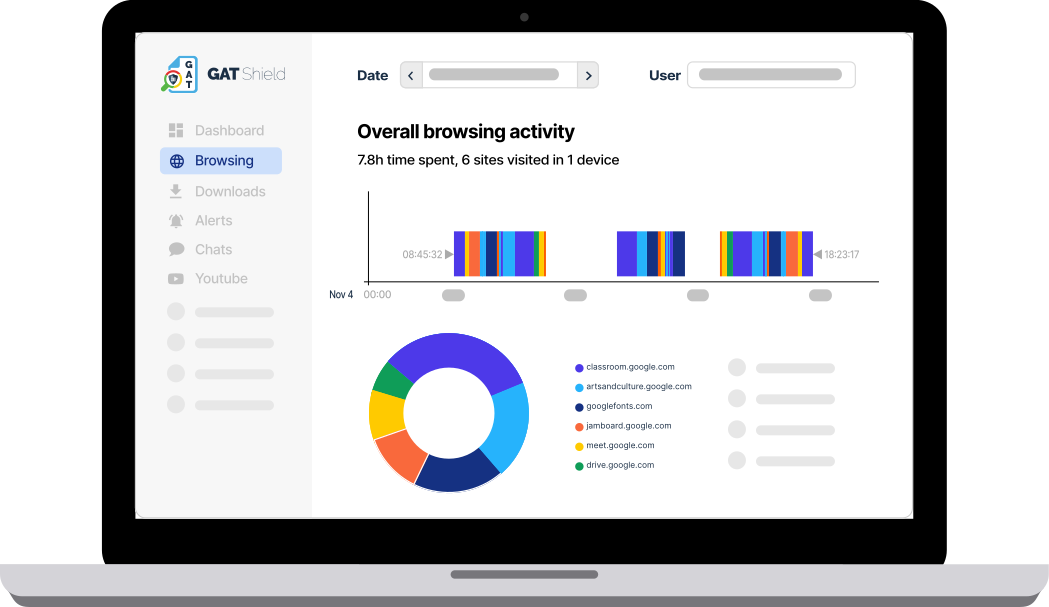
Modern collaboration increasingly happens directly through browsers. Users upload, download, share externally, copy data into AI platforms, and transfer files between SaaS applications through managed browser sessions every day.
Traditional infrastructure monitoring may capture authentication events or admin logs. However, it often misses operational behavior happening directly inside the browser layer.
For financial institutions, this creates a new category of operational awareness challenge.
Browser activity increasingly influences data movement, third-party application interaction, external collaboration, AI platform usage, unmanaged uploads and downloads, and operational workflow behavior.
As browser-centric work continues growing, operational visibility increasingly extends beyond native platform audit logs alone.
This is also why browser monitoring, DLP controls, extension governance, and browser-layer oversight are becoming more relevant to resilience planning discussions across the financial sector.
Operational Visibility Is Becoming a Competitive Advantage
Organizations that continuously monitor operational workflows across cloud environments are better positioned to investigate incidents, reduce blind spots, and manage third-party exposure.
They are also better prepared to maintain governance consistency and respond to audits more efficiently.
Under DORA, operational resilience increasingly depends on operational awareness.
This creates a major shift away from periodic compliance exercises toward continuous visibility across systems, applications, users, browsers, and operational workflows.
Financial institutions that treat operational visibility as an ongoing discipline will likely be in a much stronger position as operational expectations continue evolving across the sector. Organizations that rely only on yearly audit reviews may struggle to maintain the same level of resilience and oversight.
DORA Is Moving Beyond Traditional Compliance
DORA is not simply another regulatory framework to document internally.
For financial institutions operating in cloud-first environments, DORA reflects a broader shift toward continuous operational oversight and stronger governance visibility. Organizations also need a clearer understanding of how digital operations function in practice.
For organizations using Google Workspace, operational resilience increasingly depends on visibility into collaboration, SaaS usage, browser activity, and external sharing. It also depends on understanding how permissions and operational workflows evolve over time.
As cloud environments become more interconnected, operational resilience becomes harder to manage. Organizations that maintain visibility across the entire collaboration ecosystem will likely be better positioned for long-term resilience. Not just those focused on the traditional security perimeter.