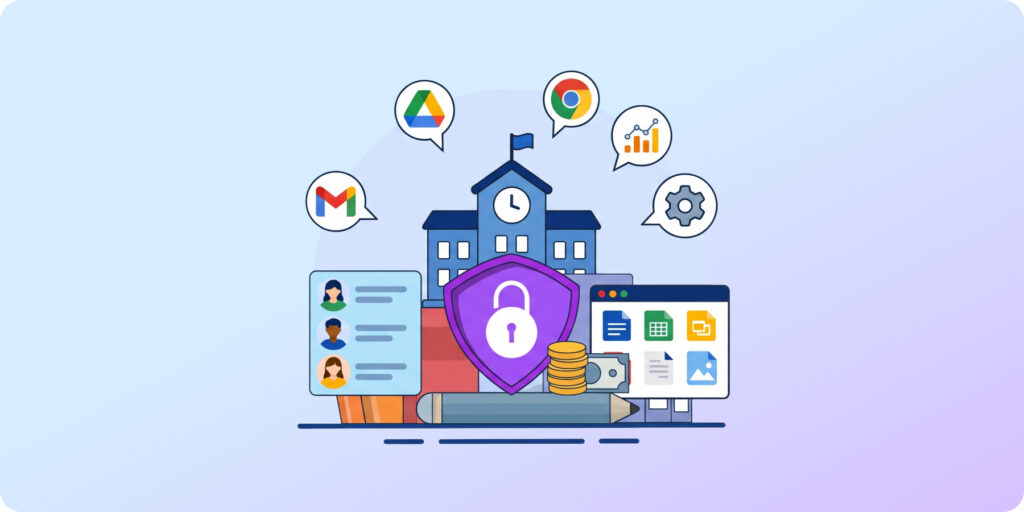

Artificial intelligence has settled down in the world of education and isn’t likely to leave anytime soon. While accessible AI-driven tools are shaping the new reality of education, their wide use can also affect schools’ online safety.
From this article, you will learn how Google admins can ensure a secure experience for students and teachers using popular AI-based solutions.
Classroom in the Time of Artificial Intelligence
Gen Z, current students, is the age group that most often uses ChatGPT and other AI tools. 1 in 4 college students collaborate with this chatbot to do their homework.
On the other hand, around half of teachers use artificial intelligence to create drafts, emails, and lesson plans.
AI is increasingly present in the educational environment, in various ways (ethical or not): during exams, when completing assignments, writing essays, planning lessons, and evaluating learning outcomes.
Chatbots, voice assistants, automated translators, and other AI-based tools are becoming the best friends of students and school staff.
Schools have accepted the new challenge and are working to unlock its full potential while maintaining ethical and educational standards. Content delivered in a few seconds by AI chatbots can greatly speed up work and support the learning process. However, school leaders realize that they can’t replace the teacher’s leading role.
AI Risks for Schools, Children & Learning Standards
The AI revolution requires the educational reality to adapt. Digital learning is evolving, and so should the security measures in the classroom. Otherwise, the AI risks for student safety may increase:
- Uncontrolled third-party AI app access to student data and devices.
- Access to inappropriate content via AI chatbots due to easy-to-bypass age limits.
- Exposure of private data when using AI apps with unclear policies.
- Cyberbullying and emotional harm caused by deepfake materials.
- Sharing sensitive data with AI assistants when seeking advice or information.
- Trusting AI-generated content weakens critical thinking and creative skills.
- Increased plagiarism and reduced independent work.
- Fake content exposure that impacts children’s trust and media literacy.
The main question many admins are asking now is: How do I secure the use of artificial intelligence in my school?
Let’s explore a few solutions.
How to Use AI Safely at School?
Readjusting safety and security solutions to address potential AI-driven risks depends primarily on your school’s policies.
Whether you allow all AI tools for everyone or restrict access to them to a specific group of users, you need to monitor students’ and teachers’ online activity at school to ensure their safety. Here’s how:
1. Third-Party AI Apps Assessment
Common AI-based applications support users in writing (ChatGPT, Grammarly), research (Gemini, Perplexity), image generation (Canva AI, Midjourney), and translation (DeepL, Google Translate).
These are just some examples of tools that users reach for educational purposes. I’m sure your students and teachers use at least one of them.
If they log in to any third-party apps with Google accounts in your domain, or install them on the school’s devices without your approval, you may have a problem called Shadow AI. They sometimes require access to Google accounts and their data, and store user data outside Google’s environment.
Regularly assess AI apps installed in your domain to avoid data leaks and compliance risks. It applies especially to new and less common apps that lack clear privacy policies. Unofficial or suspicious apps can also include unwanted files or even malware that may be installed on devices after downloading.
Proceed with a detailed assessment of third-party apps according to your school’s rules. Keep, restrict, or disable unapproved, unsafe, or distracting AI apps for students or everyone at school. Monitor files downloaded by all users to detect and remove any suspicious content.
Check out this blog post to learn how to audit all third-party apps and customize access polices for them in Google Workspace for Education.
2. Safe Browsing for AI Tools
ChatGPT and many other AI tools offer either browser, desktop, or mobile versions. While the third-party app assessment keeps downloaded applications under control, students can still access them via browsers.
To ensure compliance with your school’s polices on the use of AI and COPPA, FERPA, CIPA, and other essential regulations, user online activity monitoring is a must. Track users’ browsing in Chrome and look for URLs to specific AI-driven tools.
You don’t need to block them immediately unless they are clearly unsafe. First, register the most-visited AI app sites at your school and consider with the school board whether they are valuable. User online activity reports can also help teachers evaluate how students utilize AI in their schoolwork.
In case you determine that certain AI tools don’t provide any value to the classroom, block access to them or set up a personalized message to display when a student attempts to open the page.
- To block Google’s AI search mode and AI Overviews in the Chrome browser for students, blacklist this URL in your web filtering tool.
3. Inappropriate AI Content Detection
Whether you want to give full freedom to all users or restrict access to artificial intelligence for children, some AI features just aren’t appropriate for anyone.
Without enabling Safe Search, including image searches, users (mostly teenagers) may employ artificial intelligence to find or create deepfakes and other harmful content. Admins need to react quickly before it spreads widely and causes more damage, including cyberbullying and minors’ exposure to illicit content.
Cut the issue at the root with keyword search detection, which can identify, for instance, deepfake content. When a user attempts to generate inappropriate content using an AI chatbot, you receive a notification, and the school can take action.
4. Students Assignments Monitoring
The truth statistics show that students use ChatGPT mainly for productivity: searching for information, working, and writing. All these purposes align with the schoolwork requirements.
While teachers have already accepted artificial intelligence in the classroom, they still must defend the boundary between individual work and plagiarism. AI chatbots can assist with research, brainstorming, and content creation, but the final output should be each student’s original work.
Besides educating on responsible and ethical use of AI, schools can monitor student assignments to ensure their originality. Advanced AI detectors show exactly what content has been copied and pasted into the file, as well as what text hasn’t been written by the author alone.
Detecting AI-generated content in Google Classroom not only serves justice for those who haven’t cheated but also educates students about the consequences of unfair or unskilled AI use.
GAT Labs’ Role in Securing the AI Experience for Schools
Banning AI in schools is pointless, as the future belongs to innovation.
Artificial intelligence has become an accessible tool for online learning, bringing both benefits and challenges, and schools should chart a safe course through them. Students need to learn to use new technologies, and schools need to ensure their safe use by defining AI policies and guiding responsible use.
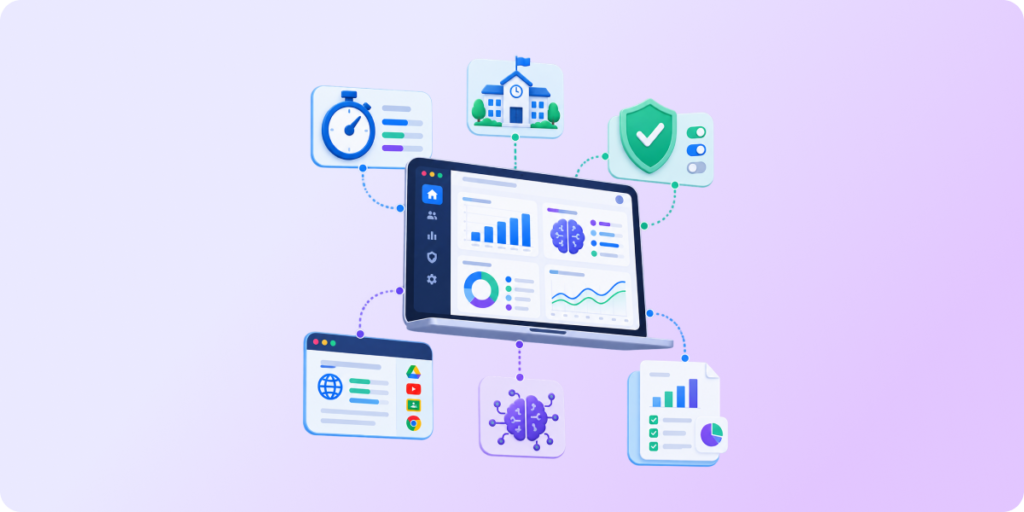
Manage AI risks effectively to create a safe online learning environment for your students and school staff. GAT Labs provides school administrators with a comprehensive range of features to monitor online activity in real time, audit external AI apps, and detect unsafe, fake, and harmful content in the Google domain. Let us help your school lead students through the new AI-driven world on a secure path.