The term showing up in every security conversation right now
DSPM is appearing in analyst reports, vendor briefings, and security RFPs with increasing frequency. If you manage a Google Workspace environment and have not come across it yet, you will soon.
Data Security Posture Management (DSPM) is the practice of continuously discovering, classifying, and securing the sensitive data your organisation holds in cloud environments. Not just knowing what data exists, but understanding where it lives, who can access it, and whether that access is appropriate.
Gartner’s 2025 Market Guide for Data Security Posture Management puts it plainly: by 2026, more than 20% of enterprises will prioritise DSPM technologies to discover and secure their data, including repositories they did not know existed. That shift is already underway.
For organisations running Google Workspace, DSPM is not a nice-to-have. It is the missing layer in your security stack.
Why Google Workspace creates a specific data challenge
Google Workspace is built for one thing: making collaboration effortless. Files move freely between users, teams, and external partners. That frictionless sharing is exactly why over 10 million businesses use it.
It is also exactly why data sprawl is so difficult to manage.
Consider a typical enterprise workflow:
1. A finance analyst creates a payroll spreadsheet in Google Drive and shares it with three colleagues
2. One colleague copies it to their personal Drive folder for easier access
3. Another shares a link with an external auditor, set to “Anyone with the link”
4. Three months later, nobody remembers the public link exists. The original analyst has left the company.
This scenario is not a security failure; it is a regular Tuesday.
Native Google Workspace admin tools were not designed to give you a comprehensive, filterable, risk-scored view of all the data in your domain. They show you a lot, but not enough. Not with the depth, flexibility, or action capability that enterprise security teams require. This is a gap that comes up constantly in Google Drive audit and management work at enterprise scale.
That is the gap DSPM fills.
The four pillars of DSPM in Google Workspace
An effective DSPM practice for Google Workspace rests on four connected capabilities.
1. Discovery
Before you can protect your data, you need to find it. True data discovery goes beyond a basic file list. It means scanning across all of Google Drive, Shared Drives, Gmail, and any connected third-party applications, surfacing files by owner, sharing status, content type, last activity, and more.
For most organisations running GAT, the first full audit is a wake-up call. The number of publicly shared files, externally accessible documents, and ungoverned data is almost always higher than anyone expected. Our knowledge base covers finding documents that contain sensitive information in Google Drive as a practical first step.
2. Classification
Not all data carries the same risk. A public product brochure and an HR salary spreadsheet are both files in Google Drive, but they require completely different treatment. Classification maps your data to its sensitivity level and its exposure risk, giving security and compliance teams a prioritised view of where to act first.
3. Remediation
Discovery and classification only matter if you can act on what you find. DSPM tooling must enable admins to fix problems at scale, revoking external shares, transferring ownership, and adjusting permissions without requiring manual, file-by-file intervention.
At enterprise scale, bulk action is not optional. Our knowledge base covers removing all permissions from sensitive folders and subfolders in bulk as a starting point.
4. Continuous Monitoring
Your data posture is not static. New files are created, new shares are made, and new risks appear every day. DSPM is not a one-time audit. It is an ongoing operational practice, supported by real-time alerts and automated policy enforcement that catches problems before they become incidents.
What DSPM looks like in practice
Imagine an IT Security Manager at a 2,000-person organisation receives a DSAR (Data Subject Access Request) under GDPR. The subject wants to know exactly what personal data the organisation holds about them.
Without DSPM tooling, this is a multi-week exercise involving manual searches, cross-department emails, and significant legal risk if anything is missed. This is one of the most common compliance pressure points we see across enterprise Google Workspace environments, and it is precisely what GDPR compliance for Google Workspace requires admins to be able to answer quickly and accurately.
With GAT as the organisation’s DSPM solution:
- 1. A domain-wide search surfaces every file, email, and document containing that person’s identifying information
- 2. Sharing permissions are reviewed, and any inappropriate access is revoked
- 3. A full, audit-ready report is generated and exported in hours, not weeks
That is a direct, measurable impact on the security and compliance posture of a real organisation.

How GAT delivers DSPM for Google Workspace
GAT is the only full-stack audit, security, and automation platform built specifically for Google Workspace. Across the suite, it gives admins, security teams, and compliance officers the tools to:
▪️ Discover every file, folder, and sharing permission across the entire domain, going beyond what Google’s native APIs expose
▪️ Audit user activity, file access, and email interactions with deep, filterable reporting through GAT+
▪️ Alert on policy violations in real time, including oversharing, external access to sensitive data, and anomalous user behaviour
▪️ Remediate at scale with bulk permission changes and ownership transfers through GAT+
▪️ Investigate sensitive Gmail and Drive content securely through GAT Unlock, where every access request requires approval from a second person and leaves a complete audit trail
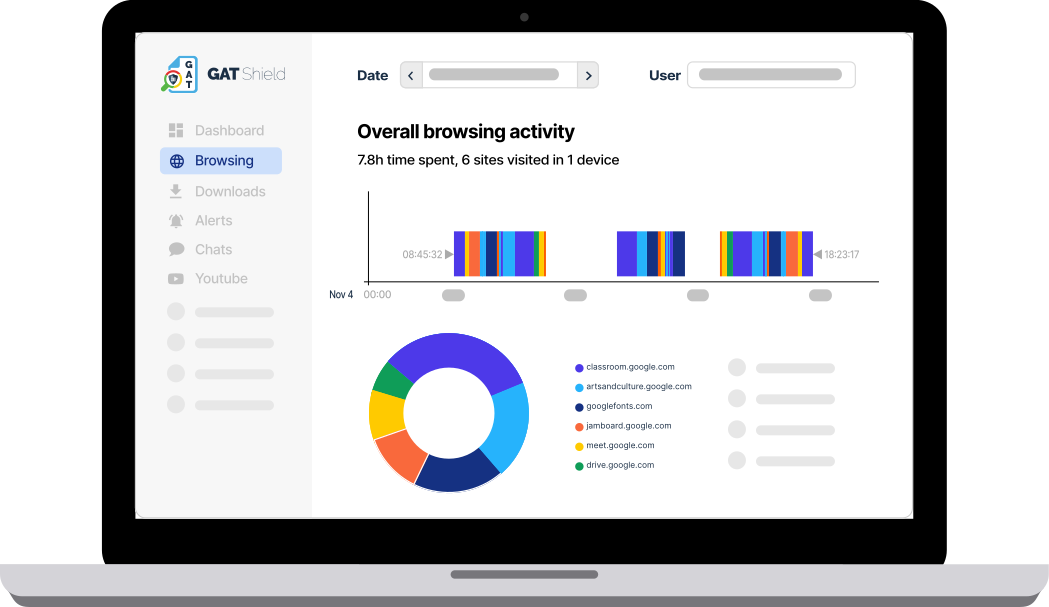
▪️ Monitor Chrome activity in real time with GAT Shield, tracking downloads, visited sites, and session behaviour, with the ability to block pages or alert on risky actions as they happen
▪️ Report for GDPR, DSAR, and internal compliance with scheduled, exportable audit data, with our full set of GDPR compliance tech tips for Google Admins as a reference
For CISOs and Compliance Officers, GAT means being able to demonstrate a documented, continuous data security posture rather than scrambling to pull evidence together when an audit or incident demands it.
The cost of doing nothing
The same Gartner report frames it well: organisations that delay are not just behind on tooling. They are accumulating what Gartner calls “unstructured data security debt,” and it compounds. The regulatory environment, including GDPR, NIS2, and a growing body of data protection legislation, is pushing organisations to move from reactive incident response to proactive data governance. The window for doing that on your own terms, before an audit or incident forces the conversation, is narrowing.
Where to start
If you are responsible for the security or compliance of a Google Workspace environment, here is a practical starting point:
- Run a full Drive audit. Identify your top 50 most-shared files and check their external sharing permissions today. Our guide on removing external collaborator access in Google Drive shows what this looks like in practice.
- Review orphaned files. Identify Drive files owned by former employees and assess their current exposure.
- Map your sensitive data. Understand what categories of data live in your domain and where the highest-risk concentrations are.
- Set up alerting. Configure real-time alerts for any new external sharing of files containing sensitive data.
GAT makes all four of these possible and automatable.
Most Google Workspace admins do not find out they have a data sprawl problem from an audit tool. They find out from an incident, a compliance request they cannot answer quickly, or a DSAR that takes three weeks to piece together manually. By that point, the exposure has already happened. Knowing where your sensitive data is, who can reach it, and whether that should be the case is not a security project. It is a basic operational requirement for anyone managing a domain at scale.