Managing Gmail signatures across hundreds or thousands of users becomes a recurring task for every Google Workspace admin.
A new employee joins. Someone changes roles. Marketing launches a campaign. The company rebrands. A phone number, department, or legal disclaimer changes.
Each update is small on its own. At scale, keeping every Gmail signature accurate and consistent turns into a standing process, not a one-time task.
Google Workspace gives admins basic options for controlling email footers. Organizations that need personalized signatures, dynamic employee data, multiple templates, and automatic updates need more centralized control.
This guide covers how to manage Gmail signatures in bulk, the tools available to Google Workspace admins, and where automation can remove repetitive work.
Why Gmail Signature Management Matters
Email signatures appear on messages your organization sends to customers, partners, prospects, and colleagues. When employees manage their own signatures, inconsistencies can appear quickly.
One employee has an outdated job title. Another is missing the current logo. Someone else is still running last quarter’s campaign banner. A required disclaimer may be missing entirely.
The larger the organization, the harder these differences are to catch and fix manually.
Centralized Gmail signature management gives admins control over what appears, who receives it, and how updates are applied.
How Google Workspace Admins Can Manage Gmail Signatures in Bulk
There are four practical approaches, depending on what you’re trying to achieve.
1. Use Google Workspace Compliance Footers
Google Workspace admins can append a footer to outgoing messages through Gmail’s compliance settings under Admin Console → Apps → Gmail → Compliance.
This works well for standardized information such as company details, legal notices, or disclaimers that apply across the organization.
An appended footer, however, isn’t the same as a personalized employee signature. If you need individual information such as a name, job title, department, or phone number, you’ll need a different approach.
Best for: A standard disclaimer or footer that’s identical for multiple users.
2. Centrally Manage Personalized Signatures
Once signatures need to vary by employee, team, department, or region, managing them individually becomes difficult at scale.
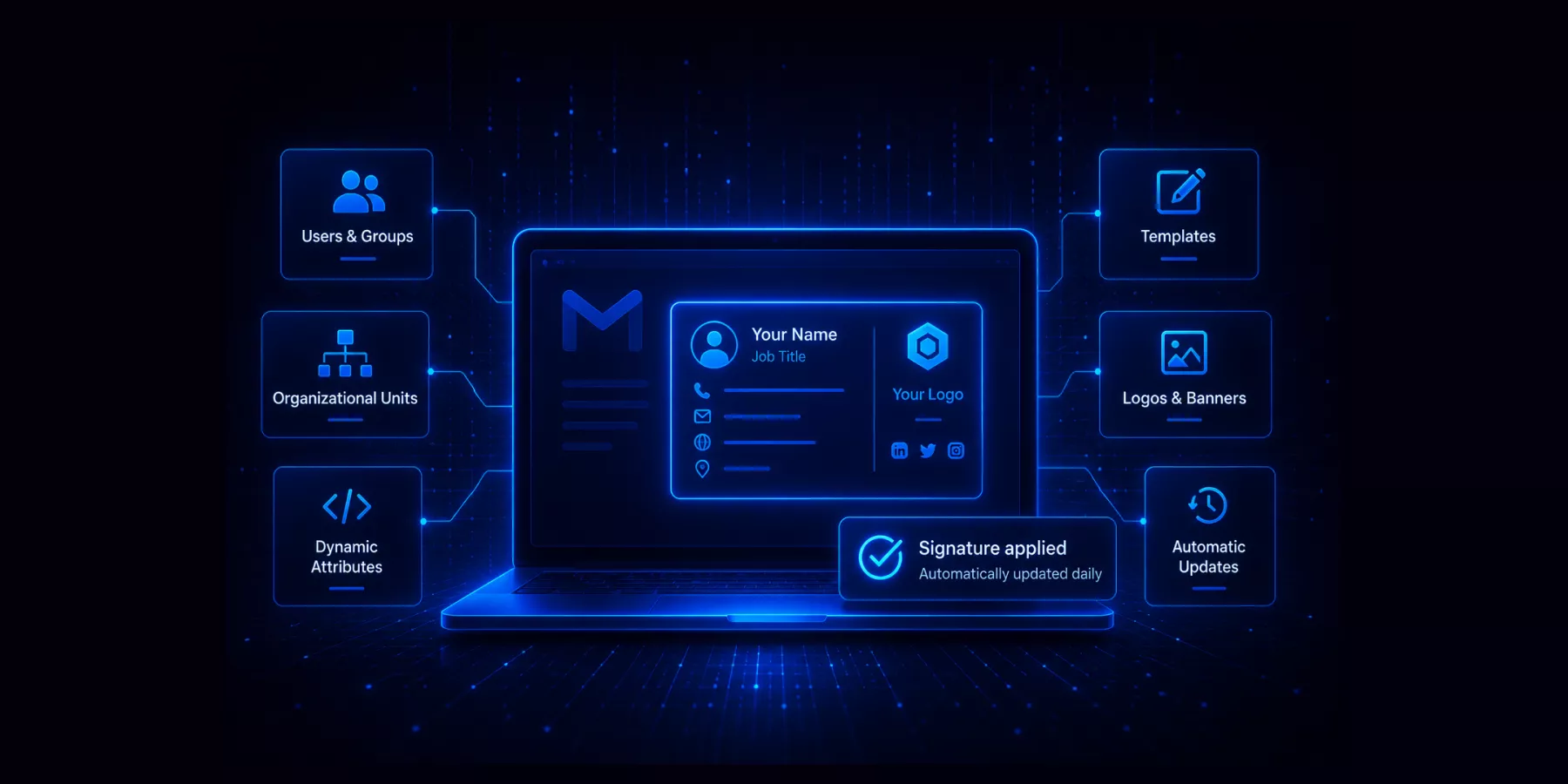
GAT Labs Email Signature Manager lets Google Workspace admins create signatures centrally and assign them by individual user, Google Group, or Organizational Unit.
Employee information can be pulled from Google Workspace directory and custom attributes, including:
Name · Job title · Department · Email address · Phone number · Organization details
Admins can build templates from scratch or import existing HTML, add logos, GIFs, banners, and social icons, and preview how a signature will appear for a specific user before applying it.
If a user qualifies for multiple signatures, assignment priorities determine which signature applies. Once assigned, the correct signature is automatically applied every day, while activity logs provide visibility into signature changes.
Best for: Ongoing, organization-wide control over personalized signatures without relying on employees to keep them updated.

3. Include Signature Changes in User Lifecycle Workflows
Sometimes a signature update is only one part of a larger employee change.
Imagine an employee moving from Sales to Marketing. Their signature may need a new job title, department, or campaign banner. Their groups, licenses, Organizational Unit, and other Google Workspace settings may also need updating.
This is where GAT Flow comes in.
Admins can include signature changes within broader onboarding, offboarding, or role-change workflows, so the signature update happens alongside the other actions triggered by the employee event.
For a practical example, see how to modify Gmail signatures for Google Workspace users in bulk with GAT Flow.
Best for: Connecting signature changes to broader onboarding, offboarding, or employee lifecycle automation.
4. Update an Individual Gmail Signature Manually
For a one-off fix, users can edit their own signature directly in Gmail:
Gmail → Settings → See all settings → General → Signature
From there, users can create or edit a signature, format the text, add an image, and choose default signatures for new emails and replies.
Best for: A single, isolated change. It becomes less practical when the same update needs to reach hundreds of employees.
What Should a Centrally Managed Gmail Signature Include?
There’s no single signature format that fits every employee.
A standard signature might include a name, job title, department, phone number, company logo, and website. Specific teams may need something different:
| Team | Common signature addition |
|---|---|
| Sales | Meeting booking link |
| Support | Help Center link |
| Marketing | Active campaign banner |
| Regional teams | Local contact details or disclaimers |
The goal isn’t to fit as much information as possible into a signature. It’s to control which information appears for which users without maintaining every signature individually.
Best Practices for Gmail Signature Management
Use directory data as your source
If an employee’s name, job title, department, or phone number already exists in your Google Workspace directory, use that information rather than maintaining it separately in the signature.
When employee information changes, you don’t want the signature to become another place that needs updating.
Build templates around real teams
Not every employee needs the same signature.
Sales may need a meeting link. Support might link to the Help Center. Marketing may run campaign banners. Regional teams may require different contact information or disclaimers.
Build templates around those requirements instead of forcing every employee into the same design.
Preview before you apply
Dynamic information can change how a signature looks. A longer job title or missing phone number, for example, can affect the layout.
Previewing the finished signature for individual users helps admins identify formatting or missing-data issues before deployment.
Keep signatures simple
Signatures need to work across different devices and screen sizes.
Avoid overly complex layouts, excessive imagery, or unnecessary information. Focus on the information employees and recipients actually need.
Google Admin Console vs. Email Signature Manager vs. GAT Flow
| If you need to… | Best fit |
|---|---|
| Add a standard footer or disclaimer | Google Workspace Admin Console |
| Centrally manage personalized Gmail signatures | Email Signature Manager |
| Assign signatures by user, Group, or OU | Email Signature Manager |
| Automatically apply signatures every day | Email Signature Manager |
| Use dynamic employee attributes | Email Signature Manager |
| Include signature changes in onboarding or offboarding workflows | GAT Flow |
| Make a one-off personal signature change | Gmail Settings |
Gmail Signature Management FAQs
1. Can Google Workspace admins manage Gmail signatures for all users?
Google Workspace admins can centrally append standardized footers using Gmail compliance settings. For personalized employee signatures, a dedicated signature management tool gives admins more control over templates, employee data, and assignments by user, group, or Organizational Unit.
2. Can Gmail signatures be updated automatically?
Yes. With GAT Labs Email Signature Manager, admins can assign signatures centrally and automatically apply them every day using Google Workspace directory and custom attribute data.
3. Can different departments have different Gmail signatures?
Yes. Email Signature Manager can assign different templates by individual user, Google Group, or Organizational Unit, allowing teams, departments, and regions to use different signatures while keeping management centralized.
4. What’s the difference between GAT Flow and Email Signature Manager for signatures?
Email Signature Manager is designed specifically for creating, assigning, and automatically applying email signatures.
GAT Flow handles broader Google Workspace lifecycle automation, such as onboarding, offboarding, and employee changes, where updating a signature can be one step within a larger workflow.
Take Signature Updates Off Your Admin List
Creating a Gmail signature isn’t the difficult part. Keeping signatures accurate as employees, teams, branding, and company information change is what creates ongoing work.
Google Workspace’s native controls can handle standardized footers. GAT Flow can connect signature changes to broader employee lifecycle workflows. And for ongoing centralized management of personalized signatures, Email Signature Manager gives admins a dedicated way to create, assign, and automatically apply them.
Create it. Assign it. Let it run.
Related Reading