Last update: October 2026
OAuth allows users to grant third-party applications access to Google Workspace data without sharing their password. Depending on the authorization granted, an app may receive access that continues beyond the user’s initial session, including through refresh tokens that can obtain new access tokens.
That persistence can create risk when an application is no longer used, but its authorization remains in place. Over time, organizations can accumulate third-party connections that still have access to Workspace data even though the original business need has changed.
OAuth abuse is now a primary enterprise attack vector
OAuth abuse has become an important security concern for organizations relying on cloud applications.
Traditional phishing attempts often focus on stealing passwords. OAuth consent phishing takes a different approach: attackers attempt to persuade employees to authorize a malicious application through a legitimate-looking consent screen.
Depending on the permissions granted, that application may gain access to Gmail messages, Google Drive files, Calendar data, or other Workspace information without needing the employee’s password.
Some OAuth authorizations can also persist beyond the initial session. This makes it important to review connected applications and revoke suspicious access directly, rather than relying solely on password resets or MFA changes.
The key insight: OAuth attacks can exploit legitimate authorization mechanisms. An application does not need to bypass authentication if a user has already granted it access.
The danger of dormant tokens
A significant OAuth governance challenge is access that was legitimately granted and later forgotten.
Consider a third-party marketing integration authorized for a short-term campaign. It may have been granted access to Gmail, Drive, Calendar, or another Workspace service. The project ends, and employees stop using the application, but the authorization may remain unless it is revoked or otherwise expires.
The same pattern can occur with project management tools, scheduling platforms, AI applications, browser-based services, and other SaaS products.
The security issue is not that every unused application is malicious. It is that access can outlive the business reason for granting it.
If the application is later compromised, or the organization no longer trusts the vendor, existing authorization can become an unnecessary path to company data.
That is why OAuth governance should include regular reviews of both active and inactive third-party applications.
Shadow IT multiplies the exposure
Dormant tokens do not exist in isolation. They accumulate because shadow IT is constant.
Users connect apps throughout the day: productivity tools, AI assistants, project integrations, and scheduling utilities. Most of these connections happen without IT review. Each one creates an OAuth token. Over time, a domain of several hundred users can accumulate thousands of active and dormant tokens across hundreds of applications, many of which no one on the IT team knows exist.
The security challenge is not one bad decision. It is the accumulation of third-party connections over time, each with its own permissions and potential exposure. Without regular reviews, administrators may lose track of which applications still need access to organizational data.
How to audit and control OAuth tokens in Google Workspace
Google Workspace gives admins native controls to review third-party applications and manage how they access organizational data.
In the Admin Console, navigate to Security > Access and data control > API controls > Manage App Access. From here, you can review apps that have accessed Google Workspace data, see which users are connected, examine requested services and OAuth scopes, and configure how apps can access Workspace data.
This gives admins a foundation for controlling third-party access. At enterprise scale, the challenge becomes identifying which apps and permissions deserve attention first, tracking whether access is still being used, and taking action consistently across the domain.
A practical OAuth audit and control framework has four steps.
Step 1: Get a complete picture
Start by reviewing the third-party applications connected to your Google Workspace environment.
In the Google Admin Console, navigate to:
Security > Access and data control > API controls > Manage App Access
Review the Accessed apps and Configured apps lists. These help you identify applications that have accessed Google data and those with administrator-defined access settings.
For each application, review:
- – OAuth scopes: What Google Workspace data can the application access?
- – Connected users: How many employees have authorized the application?
- – Requested services: Does it access Gmail, Drive, Calendar, or other services?
- – Business purpose: Is the application still required?
- – Activity and ownership: When was it last used, where reliable activity data is available, and who is responsible for it?
You can export application information for further analysis.
Prioritize applications requesting sensitive permissions, particularly those without a clear business owner or current business purpose.
Admin tip: Google’s accessed-app inventory is not a real-time activity feed. Recently granted or revoked authorizations may take up to 48 hours to appear.
GAT+ adds domain-wide visibility and application risk context, helping administrators investigate connections that may require attention.
Which OAuth scopes should Google Admins review?
OAuth scopes define what an application is allowed to do with a user’s Google Workspace data.
Not every scope represents the same level of access. An application requesting basic identity information presents a different risk from one that can access Gmail messages, Drive files, Calendar data, or other sensitive Workspace information.
When reviewing an application, ask:
- – What Workspace data can this app access?
- – Does it have read-only access or permission to modify data?
- – How many users have authorized it?
- – Does the app still have a legitimate business purpose?
- – Are the requested permissions proportionate to what the app actually needs?
The goal is not simply to find apps with broad permissions. It is to identify where the access granted no longer matches the business need.
An app approved for a short-term project, for example, may still retain access months later even though employees no longer use it.
Example: A scheduling application with Gmail access
Imagine an employee connects a scheduling tool that needs access to Google Calendar.
During an OAuth review, the administrator notices that the application also requests permission to read Gmail messages.
That does not automatically make the application malicious. However, it raises an important question: Why does a scheduling tool need access to email content?
The administrator should review the application’s functionality, confirm whether the permission is necessary, and determine whether a more limited authorization is available.
This is the purpose of OAuth scope reviews: identifying permissions that exceed an application’s legitimate business needs.
Step 2: Revoke dormant access
Applications with no recent activity and access to sensitive Workspace data should be prioritized for review.
However, inactivity alone is not proof that an application is unnecessary. Some integrations run only occasionally but support important business processes.
Before revoking access:
- Confirm the application’s business purpose and owner.
- Review its OAuth scopes and connected users.
- Check whether removing access could interrupt an approved integration.
- Revoke unnecessary authorizations or restrict the application’s access.
Google Workspace administrators can manage third-party application access through API controls. Depending on the situation, they can also revoke OAuth authorizations associated with individual users.
GAT+ helps administrators review OAuth access across the domain and identify connections that require remediation.
Remember: Removing an application’s authorization prevents further access through that authorization, but it does not necessarily delete data the third-party provider has already obtained.
Step 3: Set domain-wide app policies
Move from reactive cleanup to proactive control.
Google Workspace allows administrators to configure how third-party applications access organizational data.
From Manage App Access in the Google Admin Console, administrators can configure third-party applications using four access settings:
| Access Setting | What It Means |
|---|---|
| Trusted | The application can access Google services, including restricted services. |
| Limited | The application can access unrestricted Google services. |
| Specific Google data | Access is limited to the OAuth scopes specified by the administrator. |
| Blocked | The application cannot access Google data. |
These settings allow organizations to distinguish between approved integrations, applications requiring limited access, and applications that should not be permitted.
Before changing an application’s access, review the users and workflows that depend on it.
Admin tip: Blocking an application may interrupt existing integrations. Test changes and communicate with affected teams before applying broad restrictions.
Step 4: Monitor new authorizations
Audits show what already exists. Monitoring helps you catch new risks early.
Configure alerts in GAT+ to notify administrators when new third-party applications are detected with access to Google Workspace data. Admins can then review their permissions, assess potential risks, and take action before unnecessary access goes unnoticed.
Offboarding: don’t overlook OAuth
When an employee leaves, OAuth authorizations should be reviewed as part of the offboarding process.
Administrators should revoke unnecessary third-party access, identify business-critical integrations associated with the departing employee, and confirm whether ownership or administrative responsibility needs to be transferred.
GAT Flow can support automated offboarding workflows, helping administrators apply consistent account security procedures across the organization.
Browser extensions: the risk most admins are not tracking
OAuth-connected apps are usually the most visible risk in Google Workspace. Browser extensions are often the least visible.
When a user installs a Chrome extension, they grant permissions at the browser level rather than through APIs. Some extensions request access to read and change data across websites, which can include content viewed inside Google Workspace.
Unlike OAuth apps, this activity is not fully surfaced in the Admin Console.
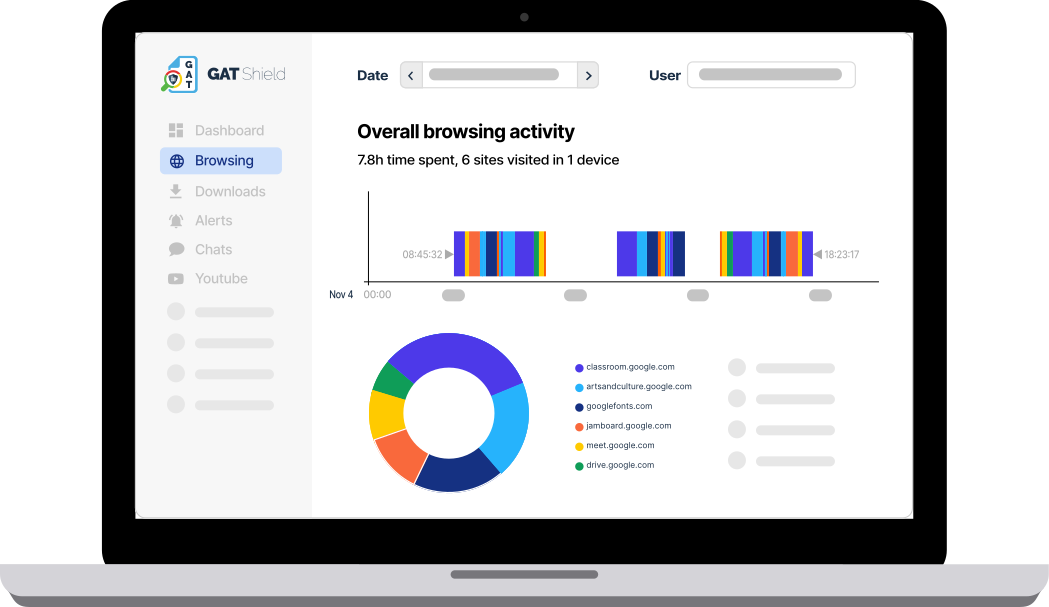
GAT Shield provides visibility into extensions across your domain, including:
- – Permission scope
- – Install date
- – Number of users
- – Risk score based on access level
This allows admins to identify high-risk extensions and take action, such as blocking or restricting them, without relying solely on traditional device management controls.
For a deeper breakdown, see the Chrome extension risk assessment guide.
The connection to Google Workspace phishing
OAuth abuse and phishing are increasingly the same attack. Attackers do not need to steal credentials when they can have users voluntarily grant access through a consent screen.
A user receives an email that appears to come from a legitimate service, a document sharing platform, a scheduling tool, or a finance integration. They click a link and are presented with a real Google OAuth consent screen asking for Drive or Gmail permissions. The application is malicious, but the consent mechanism is legitimate. If the user approves, the attacker has persistent access.
This is why reviewing OAuth-connected applications is an important part of phishing defense. MFA helps protect authentication, but it does not replace the need to review application permissions. If an employee authorizes a malicious application, administrators should investigate and revoke that authorization as part of their response.
OAuth access is becoming part of AI governance
As organizations adopt AI tools and agents that connect to Google Workspace, OAuth governance is becoming part of a wider question: what applications and AI systems can act with a user’s access?
Third-party AI tools may request access to Workspace services through OAuth, making it increasingly important to understand which applications have been authorized, what scopes they hold, and whether that access is still appropriate.
For a deeper look at this shift, read Agentic AI Security in Google Workspace.
What good OAuth governance looks like
An organization with strong OAuth governance has answers to these questions at any time:
- – Which third-party apps are connected to our domain, and what can each one do?
- – Which apps are no longer being used but still hold active permissions?
- – Which apps were connected by users without IT review?
- – What happens when a user tries to connect a high-risk app?
- – Do all departing employees have their app access revoked before or at offboarding?
If any of these cannot be answered without a manual investigation, the OAuth inventory needs a control layer.
FAQ
1. What is an OAuth token in Google Workspace?
OAuth allows a third-party application to access Google Workspace services on behalf of a user without receiving the user’s password. The permissions available to the application depend on the OAuth scopes the user or administrator authorizes.
2. Why is unused OAuth access a security risk?
An application may retain authorization after employees stop actively using it. If the organization no longer needs that access, the application retains an unnecessary connection to organizational data. Regular reviews help admins identify applications whose permissions no longer match a legitimate business need.
3. What is OAuth consent phishing?
OAuth consent phishing attempts to persuade users to authorize a malicious application through a legitimate OAuth consent flow. Instead of stealing the user’s password, the attacker seeks permission to access data through the application based on the scopes the user approves.
4. How do you audit OAuth-connected apps in Google Workspace?
Admins can review third-party applications under Security > Access and data control > API controls > Manage App Access. From there, admins can review apps that have accessed Workspace data, connected users, requested services, and OAuth scopes. GAT+ adds domain-wide visibility and risk context to help admins prioritize connections for review.
5. Which OAuth scopes should Google Workspace admins review?
Pay particular attention to applications requesting access to sensitive Workspace data or permissions that allow them to modify information. Admins should assess what the application can access, how many users have authorized it, and whether those permissions are necessary for its current business purpose.
6. How do you revoke OAuth access in Google Workspace?
Google Workspace admins can manage third-party application access through API controls. GAT+ also allows administrators to apply Trust or Ban policies to applications for specific users, groups, or organizational units. With GAT Flow, admins can revoke application tokens through Modify or Offboarding workflows, subject to Security Officer approval.
Insights That Matter. In Your Inbox.
Join our newsletter for practical tips on managing, securing, and getting the most out of Google Workspace, designed with Admins and IT teams in mind.