Shadow IT has been a problem since employees started using personal Dropbox accounts for work files. But in a Google Workspace environment in 2026, it looks very different, and it is harder to catch.
This is not about obvious policy violations. It is about the hundreds of small decisions your users make every day that your admin tools do not log and cannot see.
What shadow IT actually looks like in Google Workspace
When most people picture shadow IT, they imagine a user installing unapproved software on a company laptop. That is part of it. But in Google Workspace, the exposure points are more subtle and more persistent.
Here are the most common ones we see across enterprise domains:
OAuth-connected third-party apps: A user opens Google Drive, clicks “Connect an app,” and grants a productivity tool access to their files. That app now holds an OAuth token with persistent access — sometimes read, write, and delete permissions — across Drive or Gmail. No ticket was raised. No approval was given. The token stays active indefinitely, even if the user stops using the app or leaves the company. This is one of the fastest-growing attack surfaces in Google Workspace. Our post on OAuth app security and dormant tokens goes into detail on exactly how attackers exploit these.
AI tools processing company data: A user copies a paragraph from an internal document and pastes it into a free AI writing assistant. Or they upload a spreadsheet to an AI analysis tool to speed up a report. The data leaves your domain. It may be stored, processed, or used to train models on external servers. Your Admin console shows none of it. GAT Shield now specifically detects file uploads from your domain to external destinations, including AI platforms and file-sharing services.
Browser extensions with broad permissions: A user installs a Chrome extension to block ads, manage tabs, or translate pages. That extension may have permission to read page content on every site, including Google Workspace apps. Across hundreds of users, you have no visibility into what is installed or what it is accessing unless you are monitoring at the browser level. The 2026 threat forecast for Google Workspace identifies this as one of the growing vectors for credential and data exposure.
Personal file transfers via Chrome: A user downloads a sensitive document from Drive and uploads it to their personal Google account, Dropbox, or a project management tool the team started using without approval. The download event may appear in Drive logs. What happens after the file leaves the browser does not.
SaaS tools signed up for with work email: Your marketing team started using a design platform. Your engineers signed up for a project tracker. HR is running their own survey tool. All connected to your domain via work email addresses. None of it approved, licensed, or reviewed by IT. This is the shadow IT that scales silently. And it is rarely caught until a security review or compliance audit forces the conversation.
Why can’t the Admin console catch all of this?
Google’s Admin console is built around Google’s own product suite. It gives you strong visibility into Gmail, Drive, Meet, Calendar, and Groups. It logs user activity within those services.
What it does not provide:
– A centralized, filterable view of all OAuth tokens across your domain with full permission scope.
– Real-time visibility into what users are doing in Chrome outside of Google’s apps.
– Alerts when a user uploads a file to an external service.
– Any native view of which browser extensions are installed across your fleet and what permissions they hold.
This is not a design flaw. The Admin console does what it was built for. But if you are managing a large domain with compliance requirements ( GDPR, HIPAA, ISO 27001, SOC 2), those gaps are significant. Our overview of Google Workspace security vulnerabilities most admins miss covers several of these blind spots in depth.
The compliance angle
If your organization is subject to any data protection regulation, shadow IT creates a specific documentation problem: data has left your controlled environment, and you have no record of where it went.
Under GDPR, you must demonstrate where personal data is stored and who can access it. If a user granted a CRM-connected OAuth app access to Drive two years ago, that app may still hold your data. If it is later breached, your organization remains liable for data that left your environment without your visibility.
Shadow IT does not just create a security risk. It creates the kind of compliance gaps that are almost impossible to close retroactively. The DSPM overview for Google Workspace admins explains how this kind of data sprawl accumulates and why continuous discovery matters.
What visibility actually looks like
Finding shadow IT in Google Workspace requires looking in three places simultaneously: your OAuth app inventory, your Chrome activity, and your file transfer logs.
With GAT+, you can audit every third-party app connected to your domain, sorted by permission scope, by user, or by last activity date. The platform assigns a scope risk score to each app so you can prioritize which ones need immediate review. You can set real-time ban policies that block unauthorized apps across specific OUs or your entire domain the moment a user tries to connect them. The full walkthrough is in the knowledge base.
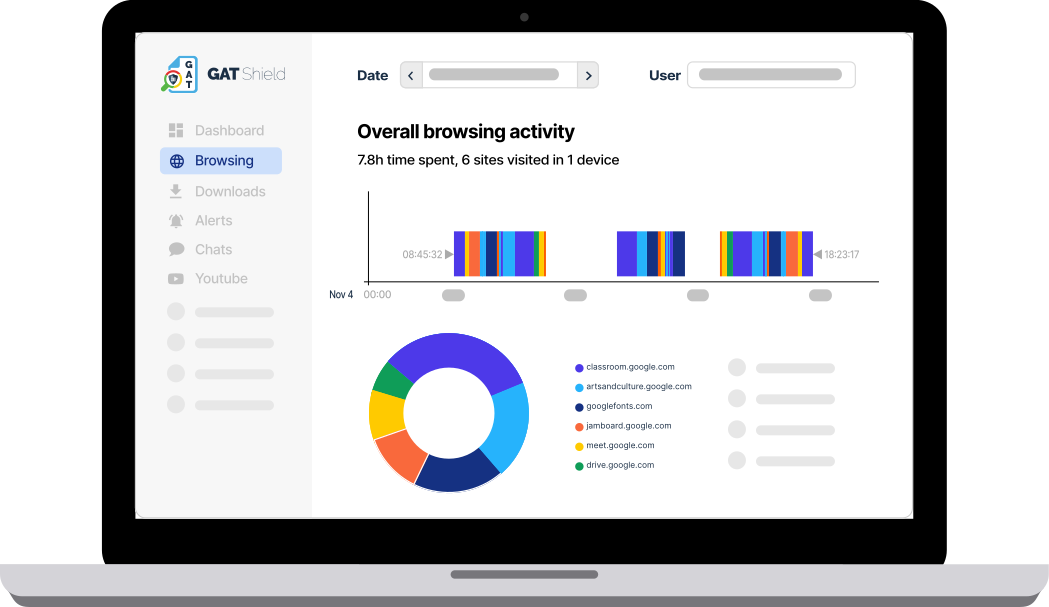
With GAT Shield, you get browser-level visibility into what sites users are visiting, what files they are downloading, which extensions are installed, and where files are being uploaded. You can set real-time alerts based on file type or file size when users download content, or when a new extension appears across your fleet. GAT Shield delivers the only Chrome DLP solution built natively for Google Workspace.
Between the two, you have a clear picture of your actual shadow IT exposure. Not a theoretical framework, but what is happening in your domain right now.
Where to start
You do not need to fix everything at once. Start by running an OAuth audit. In your Admin Console, go to Security > API Controls > App Access Control. Pull the list of connected apps. For each one with Drive or Gmail write access, ask: Did IT approve this?
In most enterprise domains, a significant number of those connections were made by users, not IT. That list is where your shadow IT exposure starts.
For a step-by-step guide on how to actually detect and control shadow IT using GAT tools, click here