For years, Google Apps Manager (GAM) has been the command-line foundation of Google Workspace administration. Many admins rely on it to manage users, permissions, and data at scale.
But as compliance requirements tighten, a critical question is emerging:
Are your GAM scripts creating Shadow Admin access that no one can fully account for?
Tools like Google Apps Manager have long helped admins perform bulk operations that the native Google Admin Console cannot handle efficiently or audit in detail. That flexibility has been valuable. However, the expectations placed on IT and security teams have changed.
Today, it is not enough to execute changes quickly. Admins must also prove who made a change, when it happened, and what was affected. In environments that rely on local scripts, that level of visibility is often missing.
The Identity Gap: Why Service Accounts Mask the Actor
The core of the audit risk lies in how Google Apps Manager interacts with the Google Workspace API. To execute bulk changes, the tool typically uses a Service Account, a non-human “robot identity” authorized to act on behalf of the domain.
When an admin runs a command, the Google Workspace audit log often records the Service Account as the performer of the action. This creates a forensic dead end. While the log confirms that a change occurred, it fails to record which human admin initiated the command. In a security incident, this lack of individual attribution prevents teams from verifying intent or identifying the source of a breach.
What is Shadow Admin Risk in Google Workspace?
Shadow Admin risk appears when administrative actions happen outside of a centralized, fully auditable system. In practice, this means actions executed through scripts do not link clearly to the individual who ran them. Instead, Google Workspace associates them with service accounts or fragmented logs.
For a Google Admin, this creates a serious operational gap. When something goes wrong, whether it is a permission change in Google Drive or a user lifecycle update, the most basic questions become difficult to answer:
Who made the change?
When did it happen?
What exactly was modified?
In environments governed by GDPR or SOC 2, this lack of clarity is not just inconvenient. It is a compliance exposure.
For a deeper look at access control best practices, see our article on the principle of least privilege in Google Workspace.
How Do Google Apps Manager Scripts Affect Audit Visibility?
GAM scripts can significantly reduce audit visibility in Google Workspace because actions are often logged under a service account rather than the individual admin who executed them.
This creates a gap in accountability. Admin teams must manually reconstruct events across logs and systems to understand what happened. When changes impact multiple services like Drive, Gmail, and user management, this process becomes slow and error-prone.
As a result, organizations experience what is commonly referred to as a Google Workspace audit gap, where activity exists but ownership is unclear.
Why Google Apps Manager (GAM) Creates an Audit Gap
The issue is not a lack of capability; Google Apps Manager is powerful. The issue is that it operates outside the visibility layer required by modern organizations.
When actions are executed through scripts, logs often reflect the service account instead of the human behind the action. That distinction is critical during audits and incident investigations.
This forces admin teams to reconstruct timelines manually. What should take minutes can take hours. Over time, accountability becomes blurred, especially in environments with multiple administrators and distributed teams.

The Maintenance Problem No One Talks About
Beyond audit visibility, there is a second structural risk in relying on GAM for enterprise management.
GAM is open-source and community-maintained. There is no vendor SLA, and updates depend on community contributions. Because the tool is installed locally, organizations often face version drift across admin environments.
Different admins may be running different versions while managing users, Drive permissions, or domain-wide changes. This introduces inconsistencies that are difficult to track and control.
Modern IT governance increasingly expects centralized, cloud-native systems where updates are consistent and security controls are enforced uniformly.
For related risks, explore our breakdown of Shadow IT in Google Workspace.
Moving Toward Audited Automation
The solution is not to remove flexibility. It is to introduce control around it.
Modern Google Workspace environments are moving toward audited automation. Actions remain powerful, but they are fully visible and governed.
Instead of relying on local scripts, organizations are adopting centralized platforms that allow admins to perform bulk actions while maintaining a complete audit trail.
This shift transforms team operations. Instead of isolated events, actions become part of a controlled system that integrates visibility, accountability, and security.
How GAT Labs Addresses Shadow Admin Risk
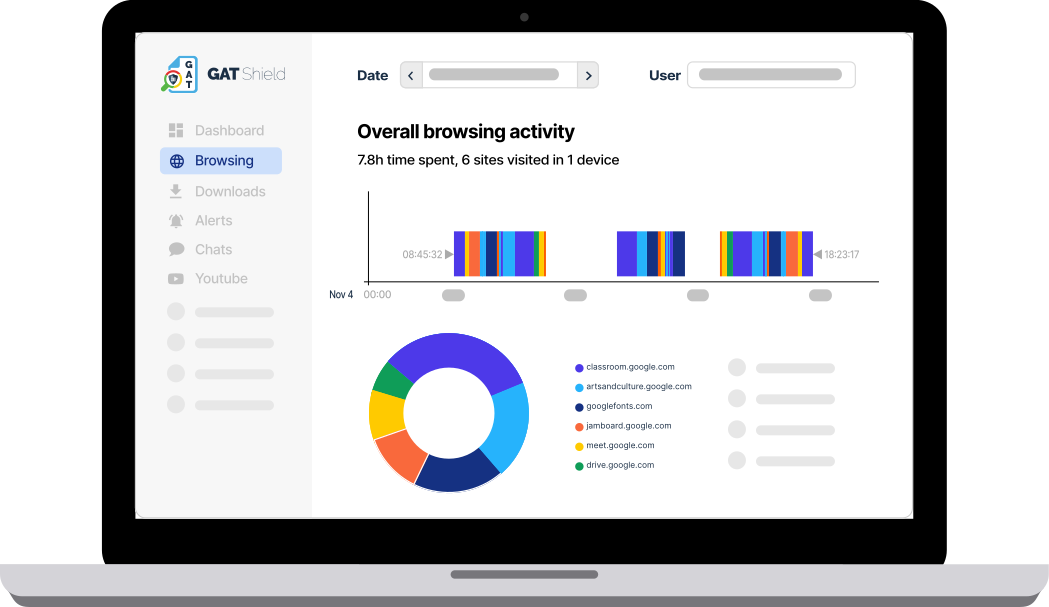
Platforms like GAT Labs are designed to close the visibility gap that scripting tools leave behind.
– Clear Accountability: Every action is recorded and linked to a specific admin, creating a reliable audit trail for both internal investigations and compliance requirements.
– Approval Workflows: For higher-risk actions, approval workflows can be introduced, ensuring sensitive operations are reviewed before execution and reducing the risk of human error or unauthorized access.
– Standardized Processes: Automation removes the dependency on one-off scripts. Standardized workflows ensure consistent onboarding, offboarding, and permission updates across the organization.
– Enterprise Support: Unlike open-source tools, GAT Labs provides dedicated enterprise support with defined response times and professional expertise.
The result is not less control, but greater control with full visibility.
Google Apps Manager vs GAT Labs: Key Differences for Admins
| Feature | Google Apps Manager (GAM) | GAT Labs |
| Interface | Command line (CLI) | Visual dashboard (no-code) |
| Audit Trail | Fragmented (service account logs) | Centralized (admin-level attribution) |
| Security | Community-maintained | SOC 2 Type II aligned |
| Execution | Local installation | Cloud-native |
| Risk Control | Manual | Approval workflows |
| Automation | Script-based | Event-driven workflows |
| Support | Community forums | Enterprise support |
Google Apps Manager (GAM) and Alternatives: Key Questions
1. What is Google Apps Manager (GAM) in Google Workspace, and what are its limitations?
Admins use Google Apps Manager (GAM), an open-source command-line tool, to manage Google Workspace environments. While powerful, it requires scripting knowledge and does not provide built-in audit trails or centralized visibility into admin actions.
2. Why is GAM considered risky for enterprise environments?
Limited accountability creates the primary risk. Service accounts, rather than individual admins, mask the identity of the person performing specific changes. This creates challenges for audits and security investigations.
3. What is the best no-code alternative to Google Apps Manager?
GAT Labs provides a centralized, no-code approach to managing Google Workspace. It combines bulk management capabilities with audit visibility and security controls.
4. Can a no-code platform replace GAM?
In most enterprise environments, yes. Modern platforms support bulk operations while adding visibility, control, and automation that command-line tools lack.
5. How can Google Admins improve audit visibility?
Improving audit visibility requires centralized logging tied to individual admins, clear reporting across Drive, Gmail, and user activity, and automated alerts. This level of visibility is difficult to achieve with scripts alone.
Final Takeaway
Google Apps Manager has shaped Google Workspace administration for years. But the expectations around security, compliance, and accountability have changed.
Today, it is not enough to execute actions quickly. Admin teams need to understand exactly what happened across their environment, who initiated it, and how to respond if something goes wrong. If that visibility is missing, the risk is not just technical. It is operational.