

Google Workspace Domain Audit #
GAT+ provides extensive Google Drive auditing for the entire domain.
Admins can apply multiple different filters to find the relevant information for any use case.
See File Count on Shared Google Drive folders #
As part of the Domain audit, GAT+ provides a detailed view of the domain’s entire Google Drive.
Using GAT+ Admins can find all Shared Drive root folders and view the item list within.
This helps admins see if the Shared folder is approaching the item limit of 500k records.
Default Google Limit for Shared Drive is 500,000 items
Root Shared Drive folders #
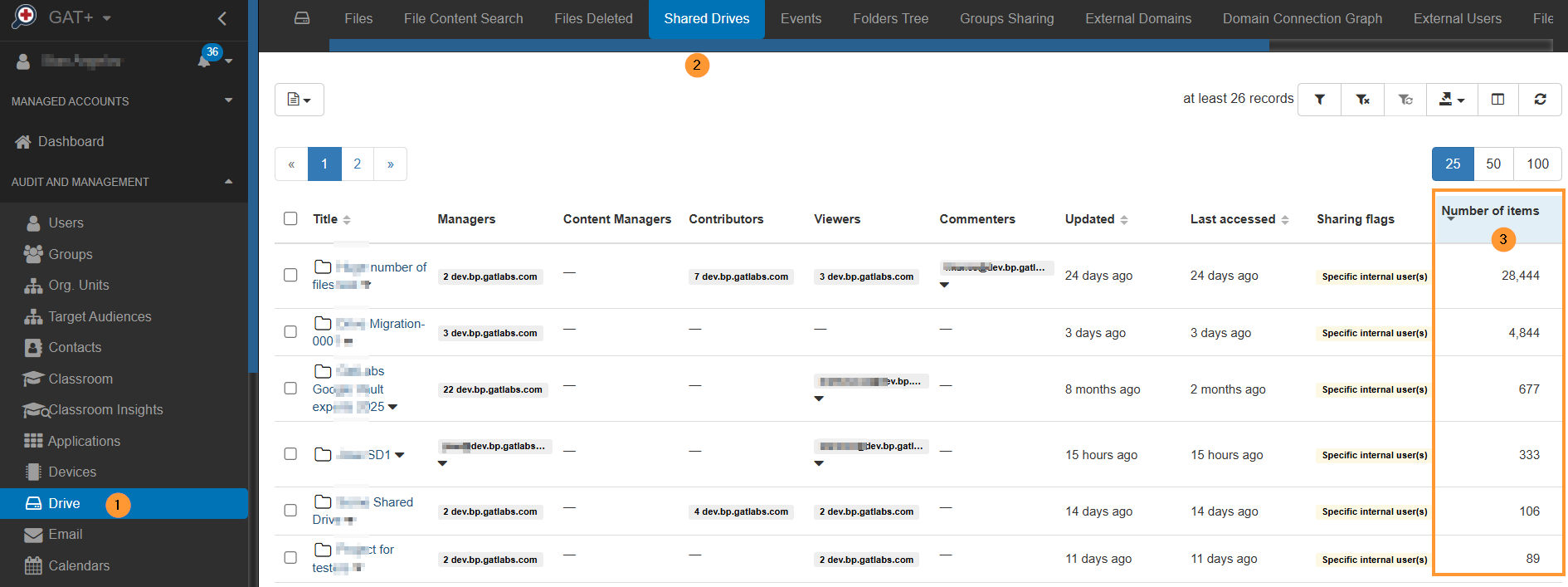
Navigate to GAT+ > Drive > Shared Drive
This will show you all the Root Shared Drive Folders of the domain.
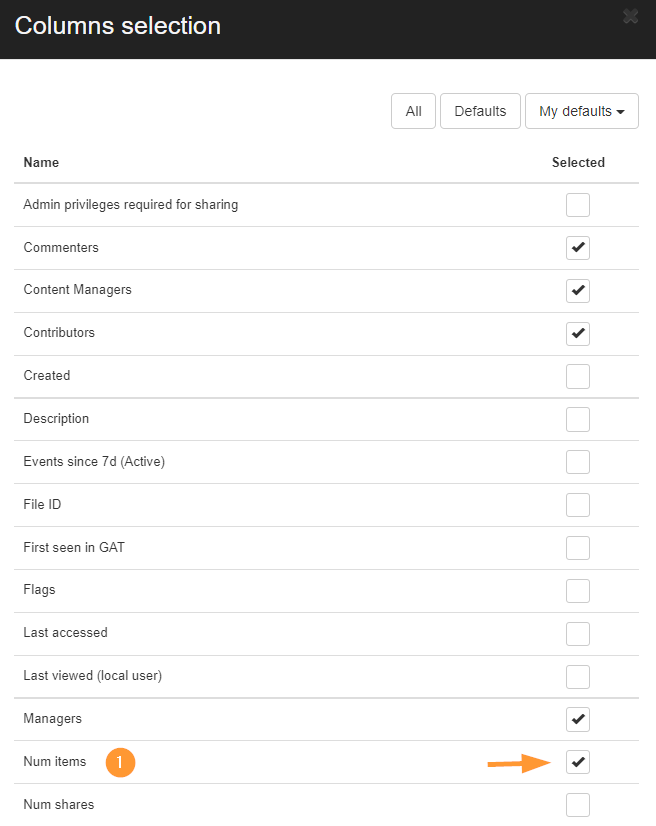
Open the “Columns visibility”

View all Shared Drives by num of items #
View the number of items for each Shared Drive folder (num items)
Select to enable the Num items field
Result #
As a result in the UI, a list of Num items will be displayed.
Click on it to filter by the volume.
Scheduled report #
Apart from seeing the num of items for each Shared Drive folder, the Admin can also set up a scheduled report.
Result of which will be noticed when num of items approaches the Google limit of 500 000 (500k) records per folder.
Apply custom filter and get notified on the “Number of items” greater than 480,000 items.
- Type – simple filter
- Num items greater > 480,000
- Scheduled
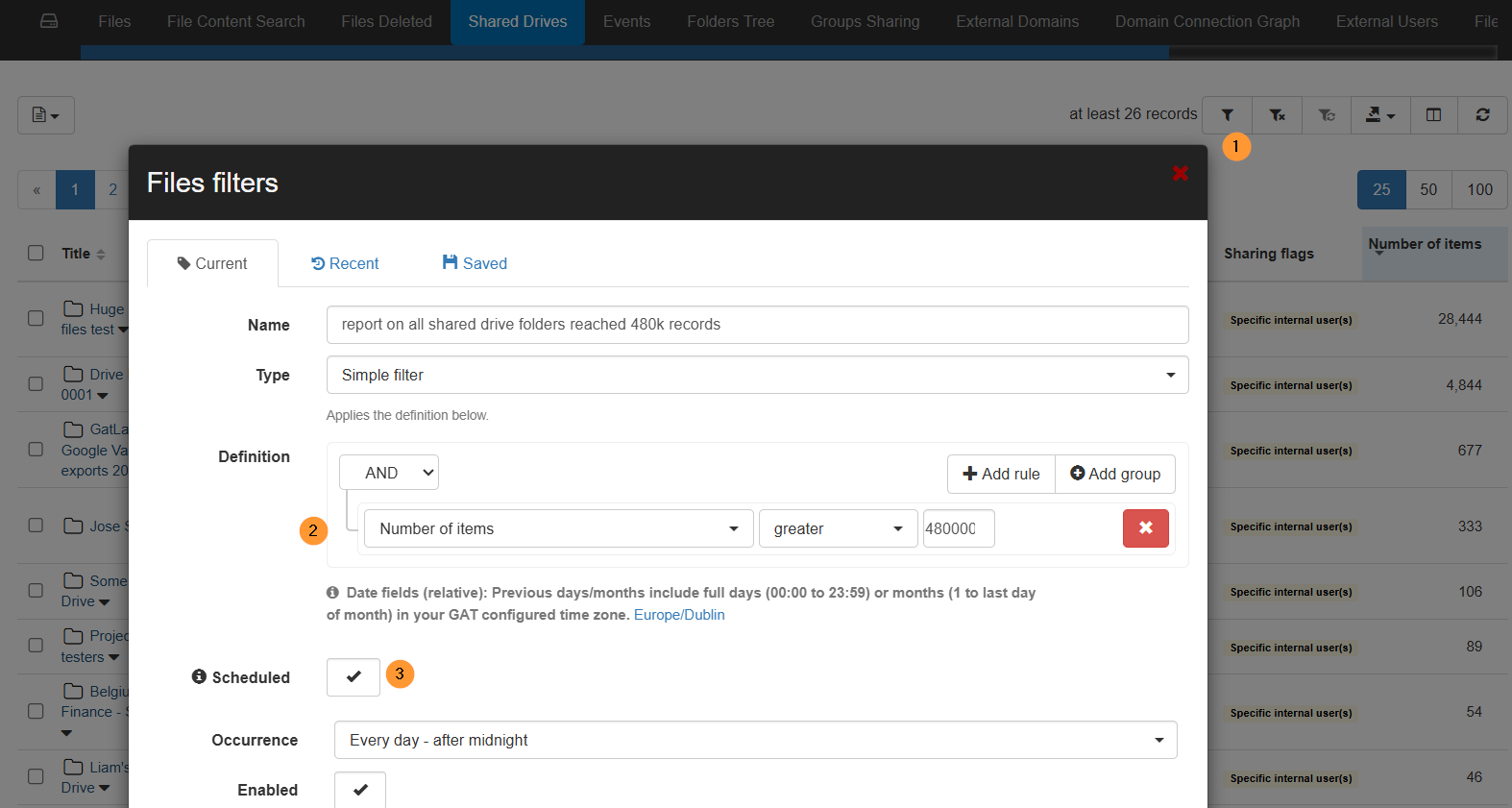
- Occurrence – set up a time when the report is to be generated
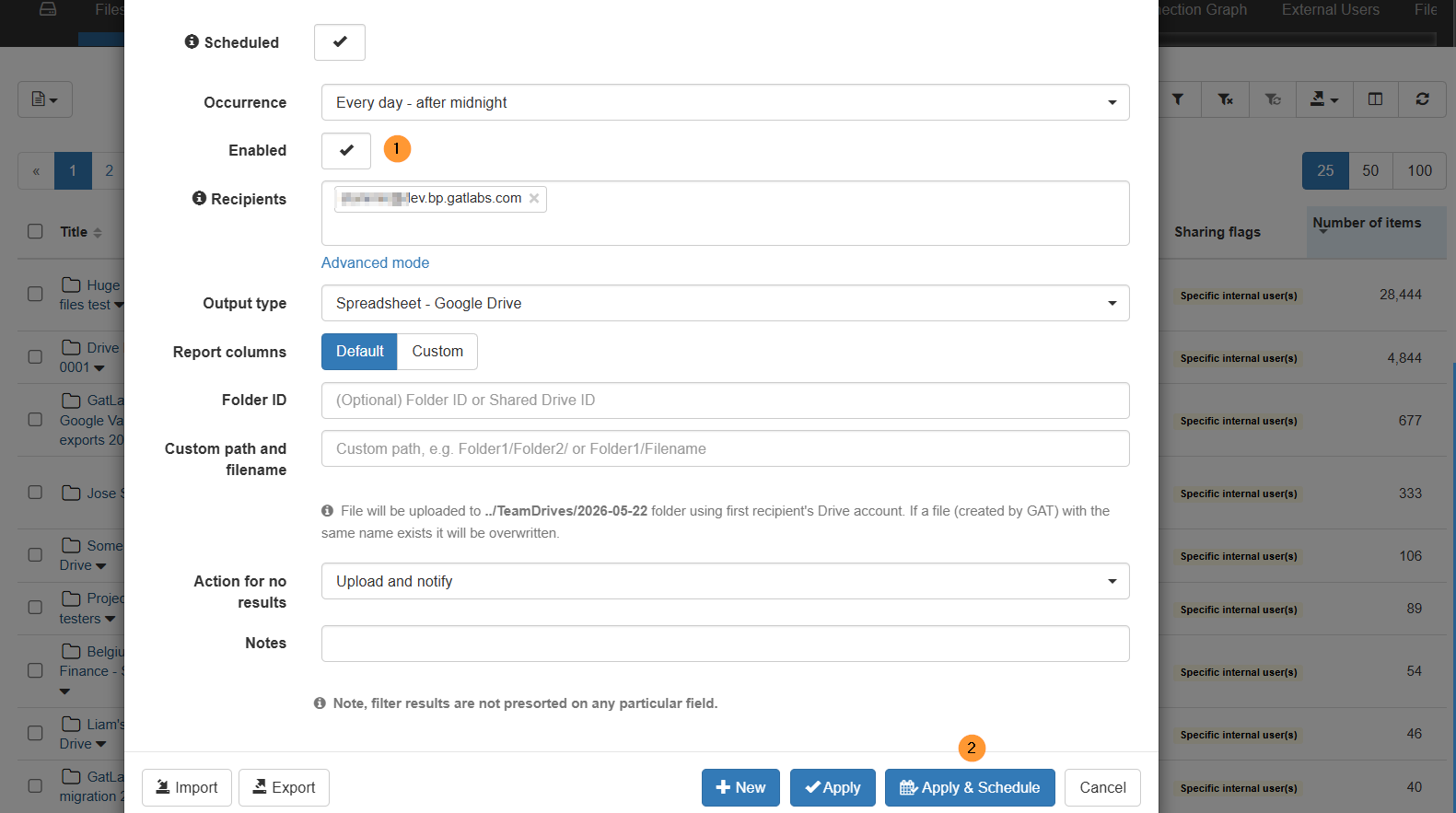
- Enabled – enable the Scheduled reports
- Recipients – enter the recipients for the report
- Output type – select the output type of the report
- Report columns – select the columns for the report
- Default – the default chosen fields
- Custom – select what fields to be shown on the report
- Custom path and filename – enter the file name of the report and where to be located
- Action for no result – when no results from the filter. There will be no notifications until some result is found.
- Apply and schedule – schedule this report to run
Key Benefits & Results #
- Immediate Visibility: Admins gain an instant, domain-wide view of all Shared Drive item counts, allowing them to sort and identify high-volume drives with a single click.
- Proactive Threshold Alerts: Instead of waiting for a Shared Drive to hit Google’s 500,000-item limit—which freezes user uploads—admins receive early-warning notifications (e.g., at 480,000 items) to take corrective action.
- Automated, Zero-Noise Monitoring: By utilizing the “Action for no result” feature, the report runs silently in the background. Admins are only notified when a Shared Drive actually breaches a specified threshold, eliminating unnecessary inbox clutter.
- Strategic Tiering: Admins can set up staggered reports (e.g., 400k, 450k, and 480k items) to track the growth velocity of high-use Shared Drives and plan data migrations or archiving seamlessly.


